here is what's in store for you this week:
(estimated reading time: 7 min)
Petroimperialism and Fossil Fascism — Updating your vocabulary about what russia actually is.
Kholodnyi Yar — The Ukrainian forest that still haunts the Kremlin.
The Pushkin Problem of Odesa — What Ukrainian decolonisation actually looks like in practice. Spoiler: heated, rough, messy.
Machism + Fascism + Extreme Patriarchy — How russian propaganda around the intensifying scramble for the Arctic exposes the operating narrative of modern russian imperialism.
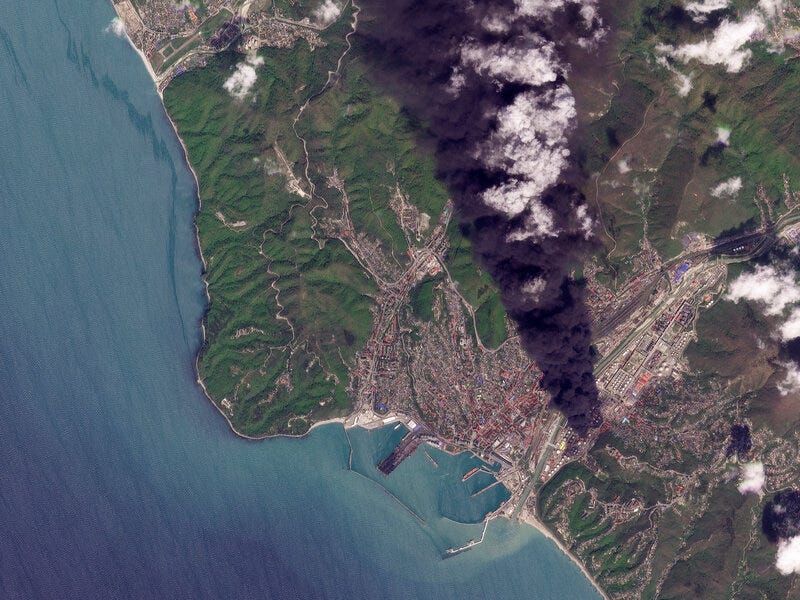
All my feeds have been filled with apocalyptic footage from a russian oil refinery ablaze, bombed by Ukraine earlier this week. But the much larger story behind it won't be covered in major news abroad.
This week, we learned about the biggest dynamic shift in the war for Ukrainian independence since 2022. For the first time, Ukraine has outbombed russia in deep strikes. The Ukrainian anti-colonial resistance continues to hit russian oil export infrastructure, ensuring the Kremlin fails to cash in on the energy crisis or keep expanding its environmentally-disastrous “shadow fleet”.
Independent calculations from the end of this March suggest that Ukraine halted at least 40% or more of russia’s oil export capacities. In 2025 alone, Ukrainian so-called ‘kinetic sanctions’ hit over 160 russian oil facilities.
This is a disruption of the russian fossil fuel industry at a scale no climate summit has ever achieved. It is the single largest forced reduction of russian fossil-fuel output in history — affecting roughly 13–14% of global fossil-fuel production from the world’s second-largest producer.
Ukraine’s goal is not only to cripple the russian war economy. It is to strike at the core engine of the russian empire itself: petroimperialism.
This particular russian kind of colonialism is based on the extraction of natural resources from unceded indigenous lands, transported over thousands of kilometres, and burned into the atmosphere somewhere in the first world. This is actively contributing to the demise of humanity as a result of the global climate disasters… The russian regime is not just another white settler empire. But it’s an empire that, specifically, built and is still able to function mostly because it’s able to extract fossil fuels from below the ground and make others burn them into the atmosphere. Which is something we should have stopped doing a very long time ago. This is fossil fascism… So basically, without the demise of the Russian Federation as this extractive colonial project, I think there’s really not a very big chance for humanity as a whole to get off this fossil fuel needle, to get away from this suicide dependence on fossil fuels, of which Russia is one of the biggest actors.
An expanded quote of Oleksiy Radynski, a Ukrainian filmmaker and anti-colonial thinker, from the interview I recorded with him for the Matryoshka of Lies audio show.
The terms ‘petroimperialism’ (an imperial power built on fossil‑fuel extraction, control, and coercive energy dependence - first articulated by a German political scientist, Elmar Altvater) and fossil fascism (the fusion of far‑right authoritarian politics with the defence and expansion of fossil‑fuel systems - coined by an American political scientist, Cara Daggett) are not new.
But as with so much else in the scholarship on imperialism and fascism, almost nobody applied this to russia, despite russia hitting every mark. Only thanks to the work of Radynski and an energy‑politics research by a Finnish scholar, Veli‑Pekka Tynkkynen, we have the first descriptions of russia as a petro-empire rooted in fossil fascism.
“An energopolitical strategy that weaponised energy in both discursive and practical terms, both inside and outside Russia, was a central factor in the Russian hydrocarbon culture. Furthermore, the hydrocarbon culture was trumpeted and sold to Russians via state media and powerful energy companies, because Putin’s regime needed to tame criticism against its one-sided economic policy and weak environmental responsibility.
Prior to 2022, Putin's Russia gave a glimpse of how not just energy but all (natural resources) flows influenced and controlled by Russia are seen as tools of leverage in both domestic politics and foreign relations. However, before the invasion of 2022, these flows were predominantly used by Russia covertly to lubricate European actors, that is, to leverage the networks of power created around the trade in raw materials to increase Russia’s influence in European politics. Only since 2022 have the whole palette of coercive measures against Ukraine, the West, and the world been openly at play.
Veli‑Pekka Tynkkynen, “How Europe got Russia Wrong” (2024)
This is the pattern I documented in the Russian Colonialism 101 guidebook, too. From never-ending russian energy blackmails to russian wars for indigenous oil fields (like re-colonisation of Ichkeria in 1994-2009, Azerbaijan in 1917-1920 or repeated invasions of Iran between 1911 and 1946, to name a few). Every single one was a petro-war. Every single one used stolen fossil fuel as a weapon.
Ukraine is the first resistance in this lineage to hit the engine itself.

But here is what Western audiences are not being told.
Russian Colonialism 101 is the first newsletter to shed light on Russian colonialism and is part of the Volya Hub network.