here is what’s in store for you this week:
The story of the Ukrainian hunger made by russian colonialism;
How russia used movies to colonise and mess with the Ukrainian national identity and history of anti-colonial struggle;
How russia used colonial architecture to reinforce cultural dominance in Ukraine.
I have grown food since I can remember myself. We come from a village; even if you are not related to farming, you still grow something next to your house. Ukrainian city-dwellers farm, too. My parents moved to the city when I was growing up, and our courtyard of a big apartment block in southeastern Ukraine was dotted with vegetable mini-gardens. If not next to your house, folks had tiny plots of land somewhere in the suburbs or on their balconies.
I always wondered: why is growing food so integral to the Ukrainian way of life?
When I was a kid, I thought it was because of our poverty. Back in the 1990s, putting self-cultivated food on our table sometimes was the only thing separating us from outright starvation. My parents would send me away to our ancestral farm for months just because they couldn't afford to feed me in the city. But even when the incomes improved, growing food remained part of our lives.
Only later did I discover that this phenomenon has more ancient roots and has everything to do with colonial violence done to Ukrainians.
Part of this is a blessing. Ukrainians have been prolific farmers for thousands of years because their soil is among the most fertile on the planet. The harvests are usually so abundant that, even today, Ukraine also feeds hundreds of millions of people around the world far beyond its borders.
The same part is also a curse. Getting a grip on Ukrainian soil became an obsession for any empire emerging next to Ukraine.
For example, during both occupations of Ukraine in 1918 and the 1940s, Germans would ship endless trains of Ukrainian grain back home and consider the colonised land a critical base for natural resources and slave labour. Robbing Ukrainians of what they farmed has been a fixture of Russian colonial occupations, too, even to this day. Since 2022, Moscow reportedly earned at least a billion on stolen Ukrainian grain alone. Russians started even stealing Ukrainian chernozem.
This theft resulted in several catastrophic famines that the Ukrainian people have endured throughout their history. Artificial hunger became a fixture of Ukrainian history and a regular fallout from endless invasions and colonial occupations. The Russian colonial rule used it several times to strengthen the colonial grip over Ukraine (and not only in Ukraine).
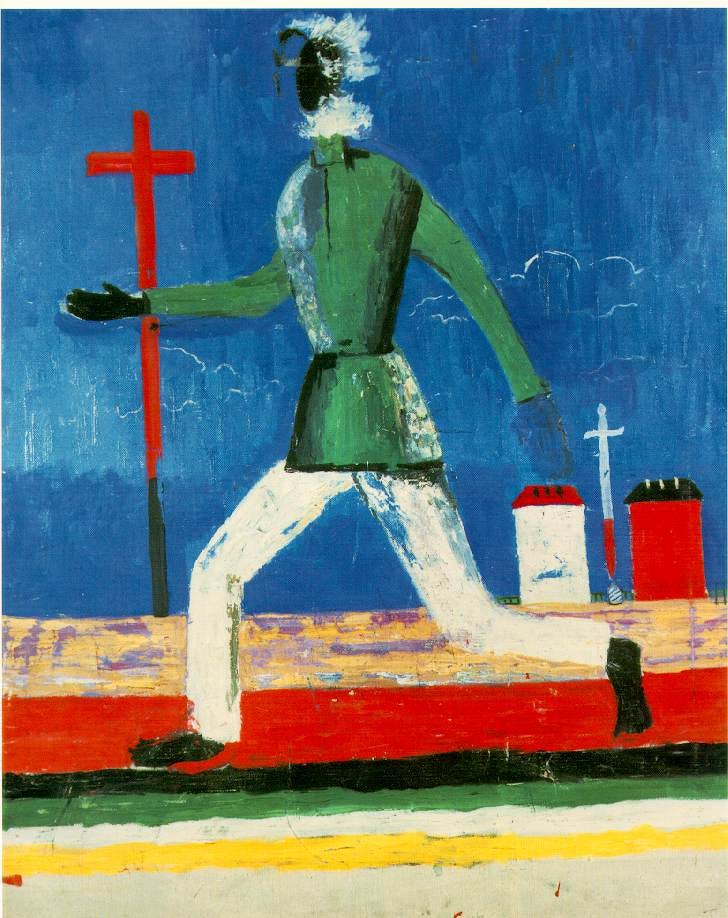
The worst of it happened in 1932-1933 when the Moscow-orchestrated starvation killed approximately between 4 and 7 million Ukrainians, affecting every Ukrainian family and killing up to 15% of the country’s population at the time. The only reason why we have such a big discrepancy in the number of victims is that Moscow stole and locked away most of the evidence in the imperial archives. At the peak of the famine, the average life expectancy was 7.3 years for boys and 10.9 years for girls.
The genocide left a deep mark on our society, especially in farming communities across Eastern, Central, and Southern Ukraine — where I am from. Self-reliant, Ukrainian-speaking folks who would harbour ancient Ukrainian traditions would be killed by it the most. This target was not random: since the Russian re-colonisation of Ukraine in 1921, the Ukrainian villages have been mounting the most active resistance to Russian occupation for many years.
Discussing this tragedy wasn't encouraged in our families out of fear. Russian totalitarian rule made sure that those who survived shut their mouths forever about it. The Kremlin keeps denying the whole existence of the Holodomor genocide and other Moscow-made famines to this day.
The modern Ukrainian research has also started including under the Holodomor umbrella man-made famines orchestrated by the Russian occupation in 1921-1923 and 1945-1947 years. They claimed fewer Ukrainian lives (up to two million and 300,000, respectively) but followed the same colonial warfare playbook as in the 1930s.
But generational trauma manifests in simple rituals, like growing foods, unnecessarily lavish family dinners, or instinctively cringing at the thought of food waste (recently labelled by scientists as neurotic eating disorders caused by intergenerational trauma)—no matter what, I must finish the meal, no matter how unpleasant the food is.
This trauma is triggered in a new way during the ongoing genocide in Ukraine. You can't imagine the sheer horror, insult, and heartbreak each and every Ukrainian experiences while watching footage of Russian occupying forces stealing Ukrainian grain and food.
You can terrorise, bomb, and torture Ukrainians, but stealing their food would inflict another level of sadism.
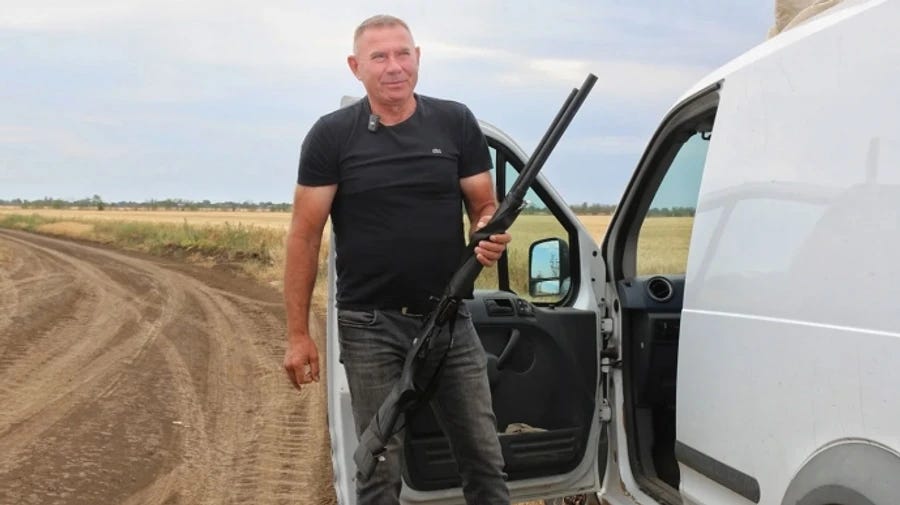
That's why growing food has also become the ultimate symbol of defiance for Ukrainians today. The tractor troops. Ukrainian farmers sowing at gunpoint and amid airstrikes, and even learning how to take down Russian drones. Even in my own garden, growing vegetables and sunflowers this year turned it into my own small, symbolic act of defiance and perseverance.
RUSSIAN COLONIAL OBSESSION WITH MAN-MADE FAMINES.
The story of the Holodomor genocide in Ukraine is one of the central pieces for a foreigner to understand the serial nature of Russian colonial abuse of this country. Russia spent decades methodically destroying and hiding the evidence — sometimes with the help of Western establishment media. The Kremlin still hoards most of the remaining archives about the genocide. That's why this mass murder, which is on par with the death toll from the Holocaust, is still largely unknown globally.
That's why works like this one, by Lia Dostlieva, a Ukrainian visual artist and cultural anthropologist, are critically important. In this essay, she highlights several key bridges between Russian colonialism and artificially orchestrated famines.
ERASED HISTORY OF UKRAINIAN WOMEN RESISTING RUSSIAN COLONIALISM FAMINES
It is quite common for the Ukrainian commemorative tradition to use the image of a woman or a girl to embody the suffering of the whole nation. In academic and journalistic discourses, the horrors of hunger are often illustrated by eerie stories about women on the brink of desperation and images of exhausted women or girls.4 Women are thus portrayed mostly as silent victims of tragic historical circumstances. But the actual history of the Holodomor includes numerous cases of active resistance to forced collectivization in which women played a crucial role. It was precisely because of the numeric predominance of women among the participants of some of those peasant revolts that they were called “Bab’i bunty” (“peasant women’s protests”) in official documents. But the story of Maria can also be read differently: even though the project has a clear commemorative intention, its female protagonist survived. For women and girls, survival in these inhuman conditions meant existential victory over the regime. Maria did not only manage to survive: she emigrated to Canada and built herself a new life there.
MANIFESTATIONS OF HOLODOMOR IN GENERATIONAL TRAUMA OF UKRAINIANS
Traumatic traces of the Holodomor can be found in certain attitudes toward food in Ukraine, especially the strong reluctance to throw away even tiny scraps of food. Despite the fact that twenty-first century Ukrainians, even during the worst of times, have always had something to eat, throwing away food scraps still produces a strong feeling of shame and guilt. To better analyze these feelings, for several months Andrii and I have kept a sort of a visual diary of wasted food. Before throwing out food scraps, we cover them with black ink and make a print on paper. We also write on the print the date, the type of food, and sometimes the reason why we threw the food away. Each of the prints also has a small piece of a landscape photograph, too small to identify the place. We added these to remind viewers that the Holodomor has left almost no trace on the landscape—unlike many collective traumas that have exact geographic locations and are present in the landscape in the form of “places of memory.”
HOW TO TELL THE HOLODOMOR TRUTH WITHOUT REPRODUCING ORIENTALIST BULLSHIT
Ukraine is often called “the granary of Europe,” which can be read both as an acknowledgment of the importance of this territory, and as a product of the colonial gaze that views these lands as a mere resource—an endless field of grain. At the same time, the people who live here are often seen as nothing more than a service workforce devoid of their own agency and voice.
REMINDER: If you refer this newsletter to at least three friends, you will receive a month of unlimited access for free.
THIS WEEK’S ANTI-COLONIAL READING LIST:
Russian Colonialism 101 is the first newsletter to shed light on Russian colonialism and is part of the Volya Hub network. What is happening to Ukraine has happened many times before, and the rest of the world has been conditioned to overlook or misdiagnose it. This isn’t history. It’s how you stop being shocked by what was always predictable.